
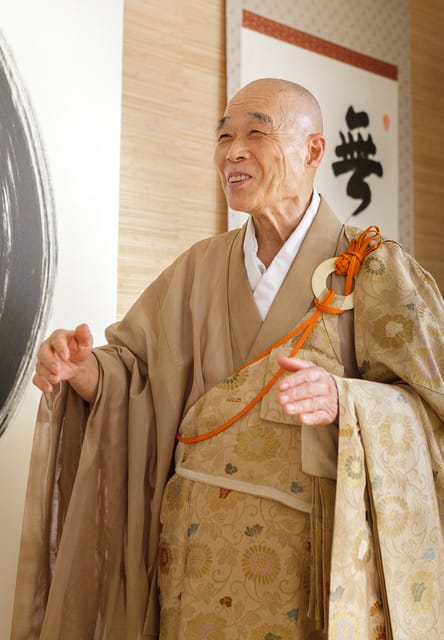
I am looking at a photograph of Shinzan Roshi sitting in my back garden in Camberwell. A broad smile lit across his face, clasped hands resting comfortably in his lap and with those expressive angular eyebrows staring back at me. It’s summer 2011 and Shinzan Roshi is visiting London for the first time to celebrate the opening of the Zenways dojo in South East London.
What does this image and so many others tell us about the man staring back at us? The man who continues to motivate and inspire our Zen practice to this day. What are the clues and fleeting images we need to follow to get us as close as we can to this enigmatic man?
Perhaps we could start with the small pack of Shiba Inus Japanese hunting dogs he cared for so attentively. Kept in closed kennels across from the temple in Gyokuryuji, these were no domesticated pets. I have this image of Shinzan cleaning out the kennels as he fed and watered the dogs daily. What was it about the fierce loyalty of these dogs that so attracted him? A very independently minded and stubborn breed, they see themselves as an equal partner in any relationship. I can also vouch for the fact that they can be aggressive. I mistakenly put a finger through the kennel’s wire mesh and nearly had it bitten off. Dogs not to be trifled with.
Or perhaps the image of a man in gardening clothes and a woollen hat greeting us on our arrival at the temple. Perfectly at ease, tools in hand. A wiry frame. A broad welcoming smile. And then the same man sitting in all of his finery on the high chair in the temple’s meditation hall giving his daily dharma talk. As we learnt over time to understand his message through openness and presence.
Or maybe the many images of coming face to face with the Roshi in sanzen. I remember one meeting between us in particular – just before the end of my last trip to Japan. As we sat cross legged together, he beckoned me to remain seated but to bow down towards him. As I did so, he reached over my prostrate torso and gave me two sharp blows on the back with his closed fan. As I lifted myself back up to a seated position in a mild state of shock, I was met with a warm smile and a clear instruction “you must help Daizan find dojo in London”. And that was that. Only later having introduced Daizan for the first time to the Butterfly tennis club and its club house (and which remains 15 years later the Zenways dojo), did I think back to that encounter.
And I can still hear the gutteral explosiveness of Shinzan Roshi’s dharma talks. The constant reminder that there is “only one mu in the whole universe” or with a vicious stroke of the arm to “cut off” man-made ideas or the need for persistence – “searching, searching, cannot find”. And always how to be “narikiru” to the moment. All resonant with his physicality.
The great 17th century Zen Master Bankei used Gyokuryuji as a hermitage for many years and I remember well his tombstone that stood outside my bedroom window on one of my stays at the temple. And it always struck me how his teaching on “dwelling in the unborn” seemed so closely to resemble the message of Shinzan Roshi to cut off man-made ideas and narikiru to the moment. With the overlapping images of these two great Zen masters.
But what strikes me now is the simplicity of so many of these images and the quiet, “being” state of mind that exudes them. And where the letting go that appears so central to them is not a doing or an intention but simply a state of being.
And there is also something else that arises and that warns us not to be deceived by the simplicity of the image. Here is the true person of no rank. A man who chooses not to rely on any externalities or identity. Even as he may seek to paint himself the fool.
So we must explore behind that open smile and understand more about the man and the journey he has taken. The trauma of failing in business and financial ruin, being disowned by his home monastery for criticizing the high level of funeral expenses, adopting an imprisoned terrorist, the destruction of a large part of the temple by fire and discovering it was uninsured. And always the dogs.
So how can we make sense of these and other traumas in Shinzan’s life and his reaction to them? Daizan was studying at the temple when the fire broke out and he helped to bring it eventually under control. And amidst all the smoking embers, Daizan still to this day has this image of Shinzan turning to him and exclaiming “All gone, everything OK”. As the man “cut off” those man-made ideas and left Daizan with that simple open smile.
But it is another image that provides me with the clearest sense of Shinzan Roshi. Some time after Shinzan Roshi’s death, Daizan returned to the temple at Gyokuryuji. To the place where he had spent years of training and studying with a teacher who was very dear to him. To the temple linked to the great Zen Master Bankei. But all that was left of the temple was a blank space where the temple had once stood. The whole temple had been razed to the ground. Not a single building or tombstone remained. A gut-wrenching blank space.
But as Daizan describes the scene, that other image re-appears. The image of Shinzan and that indelible smile. And along with it, the urge to bow down deeply to the smiling Shinzan Roshi and to all that he has left behind for us in that blank space. And after the briefest pause to pick up the rucksack where he left it and step our way forward.
Chris Owen
February, 2026