
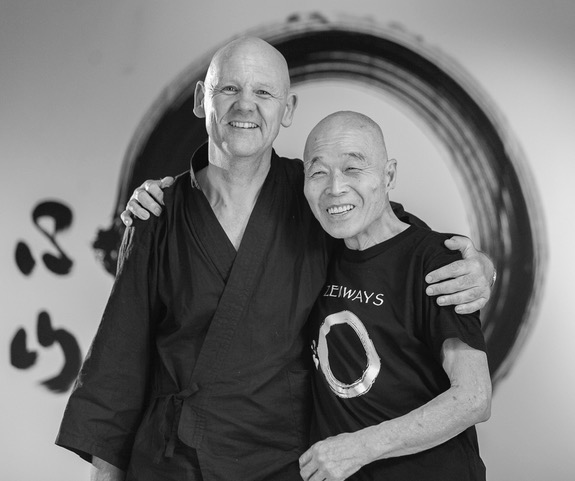
Zen Master Shinzan’s Final Teaching by Daizan Roshi
It was my last morning as a resident of Gyokuryji. I remember the temple garden seemed particularly quiet in the pale morning light. The gravel held the memory of yesterday’s rake, I could feel the coolness of the rake in my hands.
I was to leave for the airport that afternoon, to fly back to an utterly uncertain future in Europe. Zen Master Shinzan had offered to drive me the hour or so into Nagoya, where he was scheduled to give a talk in the city centre. From there I would continue on alone.
He was already becoming a little forgetful. Sometimes names seemed to drop off like autumn leaves, or moved from person to person. Dates hovered just out of reach. But the teaching continued. The practice continued. Every morning in the hall when he bowed, he bowed completely. And when he laughed, he seemed to laugh from the belly of the earth.
We sat for tea before leaving. He asked me, for the third time, when my flight was. I answered, for the third time, and we both smiled as if it were the first. My time was clear. What wasn’t clear was the time of his public talk.
It was only as we were merging onto the dual carrigeway that he glanced at the clock on the dashboard. A silence fell into the car—clear, bright, unmistakable. Then he said, very softly, “Ah.” We had left for Nagoya at precisely the time his talk was due to begin.
The next thirty minutes were unlike any other car journey I have ever taken.
He drove with astonishing focus. The old car seemed to gather intention and cut through traffic like a blade through silk. There was no panic, no muttering, no apology. Only attention – pure, undivided attention. The road curved, he curved. A truck loomed, he flowed past it. The mountains, the rice fields, the buildings blurred into green and grey strokes.
An hour’s drive in just over thirty minutes.
When we reached the hotel, people were still waiting. Dressed for an occasion, some were checking their watches, some were whispering. He did not rush in flustered or embarrassed. He ran – yes – but he ran with dignity, robes gathered in one hand, zori sandals slapping against the carpet. Carrying the bags, I panted up the stairs behind him. He bowed at the entrance as if arriving early.
Then he began.
He spoke at a speed that matched the drive. His words came like a mountain stream, fast, clear, unstoppable. There was a smile on his face, not the smile of someone covering a mistake, but the smile of someone who sees through it. He spoke of impermanence. He spoke of time. He spoke of how we are always already late for the present moment because we imagine it is elsewhere.
The audience laughed. They relaxed. Clocks became irrelevant.
And somehow, exactly on the scheduled time, he finished.
Afterwards, as we walked back to the car, I finally said what I had been holding in: “Roshi, that was… very fast.”
He looked at me with eyes that were both sharp and fading. “Fast?” he said. “Where did you find fast?”
I had no answer.
On the way to the station where I would continue toward the airport, he was quiet. The urgency had dissolved. He drove at an ordinary pace, perhaps even slower than usual. The same road that had flown beneath us now stretched urbanely ahead. The tarmac shimmered in the afternoon light.
Before I got out, he turned to me and said, “When you return to Europe, do not bring Japan with you.”
I must have looked confused, because he added, “And do not leave it behind either.”
He laughed at my expression. Then he bowed from the driver’s seat.
And though I had, as it turned out, another fourteen years studying with him, (some years even getting to Japan three times), his final teaching, as I went back to Europe, was about doing your best, about bravery and about living without hesitation. He was truly a lion.